Beyond Salary Calculations: The Importance of Payroll ERP Software
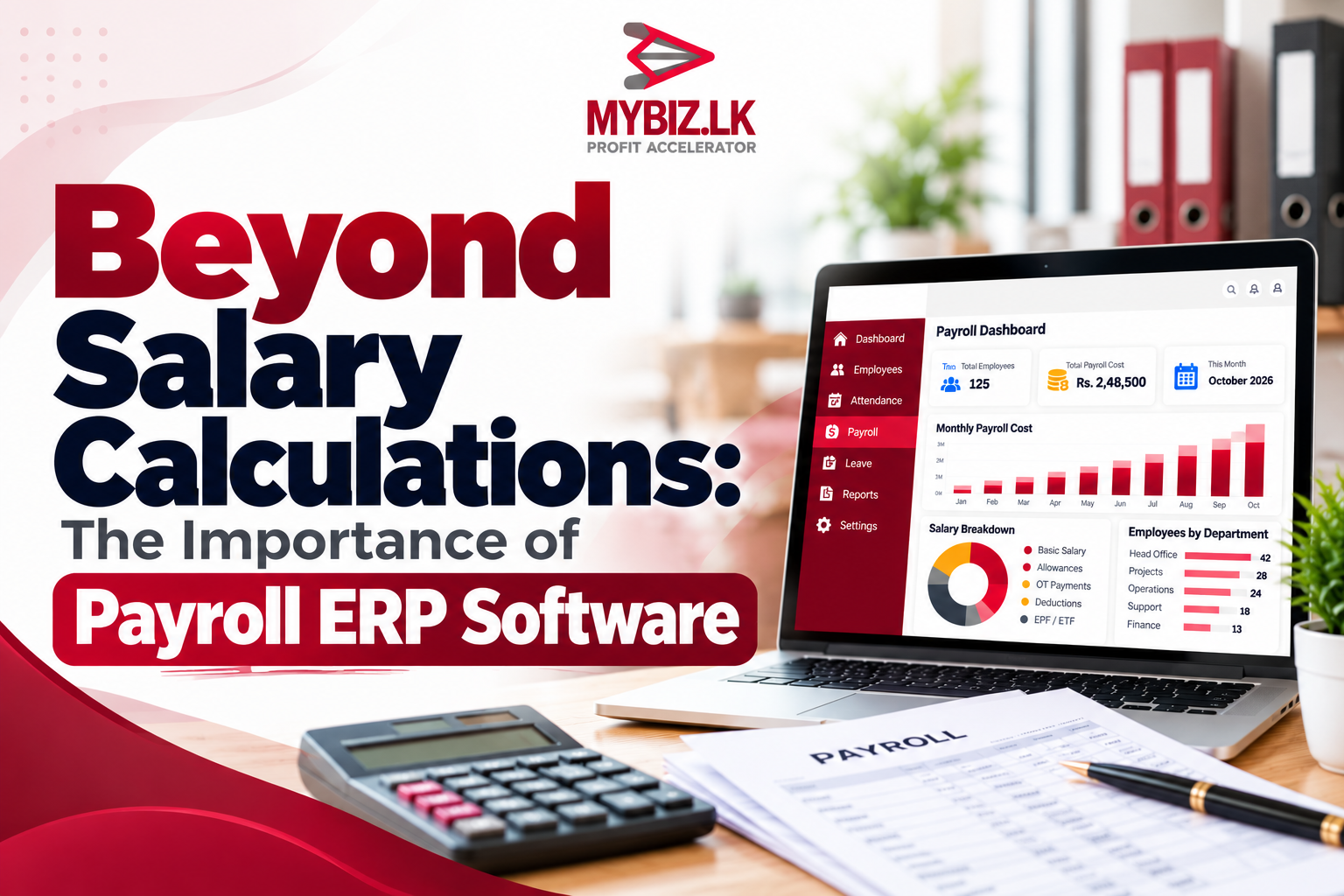
Is your payroll system simply calculating salaries, or helping you manage your business more intelligently? Modern Payroll ERP Software goes beyond monthly payments by streamlining attendance, leave, overtime, employee advances, and financial reporting. Discover how MyBiz Payroll ERP combines automation, cloud-based management, and AI-powered insights to improve accuracy, identify workforce patterns, reduce administrative work, and support smarter business decisions.
Beyond Salary Calculations: The Importance of Payroll ERP Software
Payroll management is one of the most important administrative and financial responsibilities of any organization. While many businesses traditionally associate payroll with calculating monthly salaries, modern payroll management involves much more than simply processing employee payments.
From managing employee attendance and leave to calculating overtime, handling salary advances, maintaining statutory contributions, and preparing financial reports, payroll is closely connected to an organization's overall operational efficiency.
As businesses grow, managing these processes through spreadsheets and manual calculations becomes increasingly challenging.
This is where Payroll Enterprise Resource Planning (ERP) Software plays a significant role.
Modern Payroll ERP solutions bring payroll-related activities into a centralized digital environment, helping organizations improve accuracy, reduce administrative workloads, and maintain better control over employee-related financial information.
With the introduction of Artificial Intelligence (AI), payroll management is evolving even further, allowing businesses to identify workforce patterns, monitor employee-related activities, and make more informed management decisions.
1. Payroll Management Goes Beyond Salary Calculations
Payroll management is not simply about determining how much an employee should receive at the end of each month.
It involves several interconnected processes that directly influence both employee satisfaction and business operations.
These include:
-
Managing basic salaries, allowances, and deductions.
-
Maintaining employee attendance and leave records.
-
Calculating overtime and additional payments.
-
Managing employee salary advances.
-
Maintaining EPF and ETF contribution records.
-
Generating payslips and payroll reports.
-
Monitoring employee-related financial expenses.
When these activities are managed separately, HR and finance teams may spend considerable time collecting information, verifying calculations, and correcting inconsistencies.
A modern Payroll ERP system helps organizations bring these activities together, creating a more structured and efficient payroll management process.
The real value of Payroll ERP Software lies not only in calculating salaries but also in improving the management of payroll-related business operations.
2. The Challenges of Traditional Payroll Management
Many organizations still depend on spreadsheets, manual records, and disconnected systems to manage employee payroll.
Although these methods may work for smaller teams, they often become inefficient as the workforce expands.
Manual Calculation Errors
Payroll calculations involve several components, including basic salaries, overtime, allowances, deductions, and salary advances.
Manual calculations increase the possibility of errors, which may result in incorrect salary payments and additional administrative work.
Time-Consuming Administrative Tasks
HR and accounting departments frequently spend significant time collecting attendance records, reviewing leave details, calculating overtime, and preparing monthly payroll reports.
These repetitive tasks reduce the time available for more strategic responsibilities.
Disconnected Employee Information
When employee information is maintained across different spreadsheets and documents, ensuring accuracy and consistency becomes difficult.
Limited Financial Visibility
Without centralized payroll information, management may struggle to monitor salary expenses, overtime costs, and other employee-related payments.
These challenges demonstrate the importance of adopting a more integrated approach to payroll management.
3. Improving Payroll Accuracy Through Automation
Accuracy is essential in payroll management.
Employees expect their salaries to be calculated correctly and paid on time, while businesses must maintain reliable financial records.
Payroll ERP Software can simplify repetitive calculations involving:
-
Basic salaries.
-
Employee allowances.
-
Overtime payments.
-
Salary deductions.
-
Unpaid leave adjustments.
-
Employee advance payment deductions.
-
Other payroll-related payments.
By applying predefined payroll rules, an automated system can reduce manual calculations and improve consistency.
Automation also allows HR and finance teams to spend less time performing routine calculations and more time reviewing payroll information.
However, reliable results still depend on accurate employee data and properly configured payroll policies.
Payroll automation is not simply about processing salaries faster. It is about improving accuracy, consistency, and operational efficiency.
4. Integrating Attendance, Leave, and Payroll Management
Employee attendance and leave records directly influence payroll calculations in many organizations.
For example, overtime hours may affect monthly earnings, while unpaid leave may influence salary deductions.
When attendance and payroll information are managed separately, HR teams may need to transfer information manually between systems.
An integrated Payroll ERP solution helps organizations maintain more consistent records and reduce duplicate data entry.
Businesses can benefit from:
-
Organized employee attendance records.
-
Centralized leave information.
-
Improved overtime tracking.
-
Reduced manual data transfers.
-
Better coordination between HR and payroll departments.
Integrating these activities creates a more efficient payroll workflow and helps organizations maintain accurate employee-related information.
5. Managing Employee Salary Advances and Deductions
Employee salary advances are another important aspect of payroll administration.
Businesses may provide advance payments to employees before their regular salary dates. These payments must be properly recorded and considered during payroll processing.
When salary advances are managed manually, organizations may face difficulties tracking outstanding amounts, payment histories, and related deductions.
A structured payroll management system can help businesses maintain organized advance payment records and improve financial visibility.
This supports more accurate salary administration and better coordination between HR and finance teams.
Effective advance payment management helps businesses maintain financial control while ensuring greater transparency in employee payroll records.
6. Supporting EPF, ETF, and Statutory Payroll Requirements
For businesses operating in Sri Lanka, payroll management also involves statutory responsibilities.
Employers must consider applicable requirements relating to the Employees' Provident Fund (EPF), Employees' Trust Fund (ETF), and other relevant payroll obligations.
Maintaining accurate employee information and reliable salary records is essential for preparing statutory contribution details.
Payroll ERP Software can support organizations by helping them organize relevant payroll information and maintain consistent records.
Businesses must nevertheless ensure that their payroll configurations reflect current legal requirements and that required contributions and submissions are completed correctly.
A well-organized payroll system supports statutory administration, improves recordkeeping, and helps reduce avoidable payroll-related errors.
7. AI-Powered Payroll Management: Turning Employee Data into Business Insights
Traditional payroll systems primarily focus on recording information and processing salary calculations.
However, modern businesses increasingly require systems that can also help them understand employee-related trends and identify operational patterns.
This is where Artificial Intelligence (AI) introduces additional value.
MyBiz Payroll ERP incorporates AI capabilities designed to support workforce monitoring and payroll-related analysis.
Rather than simply storing employee information, AI-supported analysis can help organizations identify patterns that may otherwise be difficult to recognize through manual reporting.
AI-Based Attendance Monitoring
Employee attendance data provides valuable information about workforce availability and operational consistency.
AI-supported attendance monitoring can help organizations analyze attendance trends and identify unusual or recurring patterns.
For example, HR teams can use attendance insights to review frequent absences, irregular attendance behavior, and changes in workforce availability.
These insights can support more informed workforce management and help HR departments identify areas requiring further review.
AI-Based Leave Pattern Analysis
Employee leave information can reveal important workforce trends.
AI-powered leave pattern analysis can help organizations identify recurring leave patterns, changes in leave frequency, and periods of increased employee absence.
This information may assist management with workforce planning, resource allocation, and operational scheduling.
Importantly, AI-generated observations should support human review rather than automatically determine employee performance or disciplinary outcomes.
AI Monitoring of Employee Advance Payments
Employee salary advances can also provide useful information for payroll and financial management.
AI-supported monitoring can help businesses analyze advance payment histories, identify recurring payment patterns, and review employee-related advance transactions.
These insights may support improved financial planning and more structured advance payment administration.
Supporting Better Management Decisions
The value of AI in payroll management extends beyond identifying individual patterns.
By analyzing relevant payroll and workforce information, AI-supported tools can provide insights that help organizations review operational trends and improve administrative planning.
For HR and finance departments, this represents an important shift from routine data processing towards more informed decision-making.
With AI-powered monitoring, Payroll ERP Software can become a valuable source of workforce and financial insights rather than functioning solely as a salary calculation tool.
AI insights should always be used with appropriate data protection, access controls, and human oversight.
8. Better Payroll Reporting and Financial Control
Payroll expenses represent a significant recurring financial responsibility for many businesses.
Therefore, payroll information is valuable not only to HR departments but also to finance teams and business management.
Modern Payroll ERP solutions can support organized payroll reporting and financial analysis.
Depending on the available configuration, useful reports may include:
-
Monthly payroll summaries.
-
Employee salary details.
-
Department-wise payroll expenses.
-
Overtime payment summaries.
-
Allowance and deduction reports.
-
Employee advance payment records.
-
Payslips and payroll histories.
Access to organized payroll information helps management understand employee-related expenses and make more informed financial decisions.
For growing businesses, this visibility becomes increasingly important.
9. The Importance of Cloud-Based Payroll ERP Software
As organizations continue adopting digital technologies, cloud-based business management solutions are becoming increasingly relevant.
Cloud-based Payroll ERP Software provides a flexible approach to accessing and managing payroll-related information.
Potential advantages include centralized data access, improved coordination between departments, scalability, and more efficient reporting.
For organizations operating across multiple locations or departments, centralized payroll information can reduce the complexity of maintaining disconnected records.
Cloud-based systems may also support integration with other business applications, depending on the software architecture and available capabilities.
However, businesses should evaluate data security, user permissions, backup arrangements, and privacy requirements when selecting a payroll platform.
10. Why Sri Lankan Businesses Should Consider Modern Payroll ERP Software
As businesses expand, payroll management becomes more complex.
Increasing employee numbers, different salary structures, overtime arrangements, statutory obligations, and internal administrative requirements can make manual payroll processing difficult to maintain.
For Sri Lankan organizations, adopting a suitable Payroll ERP system can help establish a more organized approach to employee payment administration.
Beyond operational efficiency, modern payroll software can also support better financial visibility and workforce management.
With AI-powered analysis becoming part of modern business applications, organizations have additional opportunities to understand employee-related trends and improve administrative decision-making.
The transition from manual payroll processes to an integrated digital system is therefore more than a technological upgrade.
It represents an opportunity to improve how organizations manage their people, financial responsibilities, and everyday operations.
11. Modernize Your Payroll Management with MyBiz Payroll ERP Software
At MyBiz, we understand that effective business management requires accurate information, efficient processes, and reliable digital solutions.
MyBiz Payroll ERP Software is designed to support businesses moving towards more organized and technology-driven payroll management.
The solution combines a cloud-based ERP approach with automation, centralized information management, and AI-supported monitoring capabilities.
Its AI capabilities include monitoring and analyzing employee attendance, leave patterns, and advance payment activities, helping businesses gain additional visibility into workforce-related information.
By bringing payroll-related processes into a modern digital environment, MyBiz aims to help organizations reduce administrative complexity and support better business management.
Whether an organization is seeking to modernize existing payroll processes or improve visibility into employee-related operations, selecting the right ERP solution is an important step towards digital transformation.
Conclusion: The Future of Payroll Is Beyond Calculations
Payroll management has evolved beyond the traditional process of calculating monthly salaries.
Today, businesses need to manage attendance, leave, overtime, employee advances, statutory records, and financial reporting as interconnected activities.
Modern Payroll ERP Software provides an opportunity to improve these processes through automation, centralized information, and better operational visibility.
With AI-powered monitoring and analysis, businesses can also gain deeper insights into workforce patterns and employee-related financial activities.
For growing Sri Lankan businesses, investing in suitable payroll technology can support more accurate administration, improved efficiency, and informed decision-making.
The future of payroll is not just about calculating salaries. It is about managing people, processes, and business information more intelligently.
Take Your Payroll Management Beyond Calculations
Discover how MyBiz Payroll ERP Software can help modernize your payroll operations with automation, centralized management, and AI-powered workforce insights.
Request a Demo Today!
Website: www.mybiz.lk
Email: [email protected]
Phone: 077 772 1122
MyBiz — Profit Accelerator
About Us
At Csquare Technologies (MyBiz.it.com), we help businesses streamline operations with AI-powered automation. With over 15 years of ERP and automation expertise, we’ve transformed workflows across finance, construction, retail, and hospitality. If your organization still spends valuable time on repetitive tasks, it’s time to change.
👉 Consult us today to discover how our AI solutions can save you time, reduce costs, and accelerate profits.
Need help automating your business?
Book a free consultation—roadmap, cost savings, and automation checklist tailored to your business.
Call +94 777 721122 WhatsApp